
Top Stories
More From Our Blogs
Pest Control Advice and Tips

Why Do Foxes Scream at Night? A London Guide
Why do foxes scream at night? The fox mating season explained, the noises you hear in London gardens, whether foxes attack cats and how to deter them.
It usually starts after midnight: a single, piercing shriek from somewhere behind the garden fence, followed by another. Plenty of Londoners have been woken by it and assumed someone was being hurt. In almost every case it is a fox, and if you are hearing it now, in late autumn and winter, you are hearing the start of the fox breeding season. This guide explains why foxes scream at night, what the other noises mean, whether foxes are a danger to cats, and what you can do to make your garden less attractive to them.
Why do foxes scream at night?
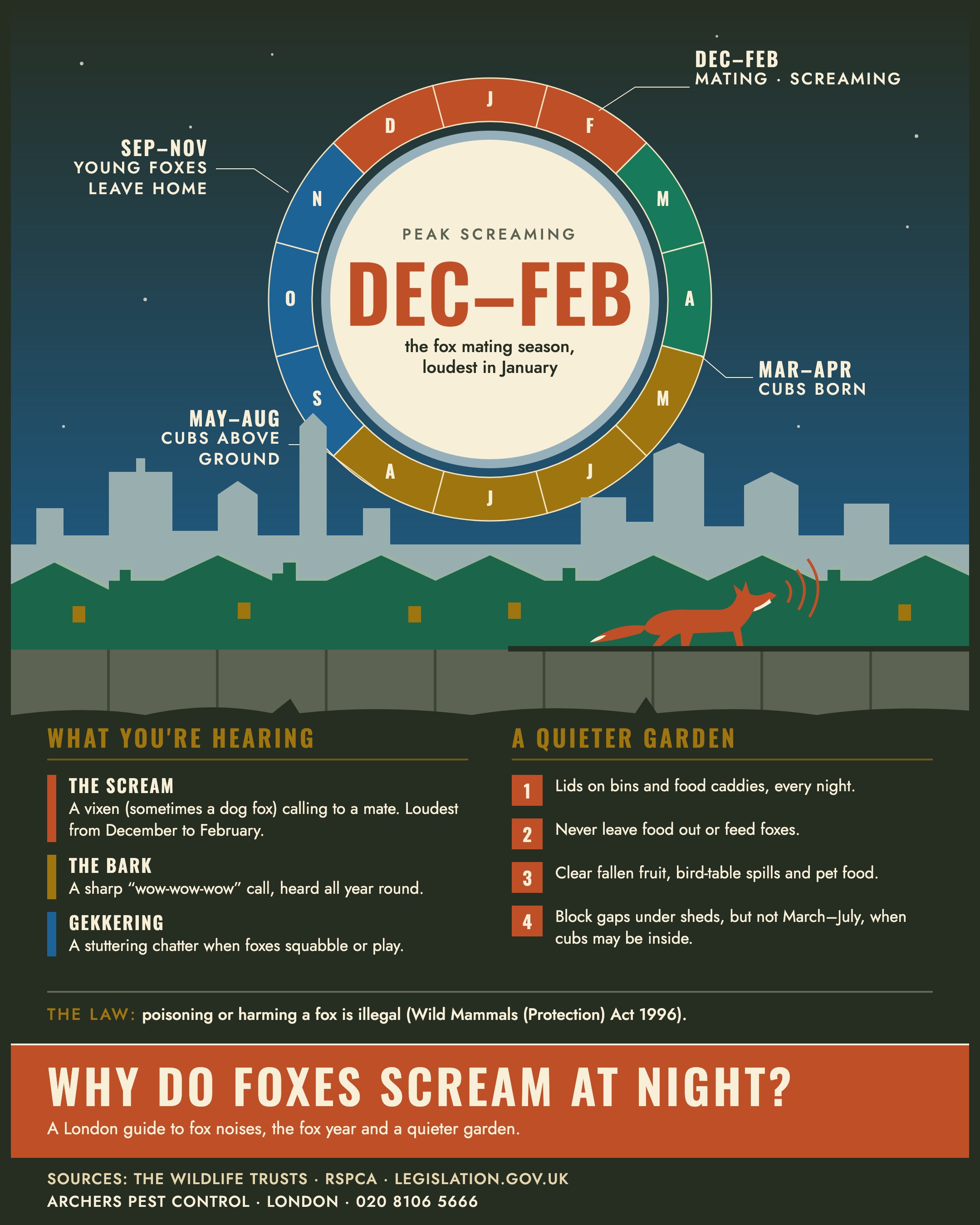
The scream is a call, not a cry of pain. Red foxes are most vocal during their mating season, which in the UK runs roughly from December to February and peaks in January. The classic blood-curdling scream is most often made by a vixen (female) letting dog foxes know she is there and ready to breed, although dog foxes scream too. Because foxes are mostly active from dusk until dawn, and because sound carries a long way on still, cold nights, the calls seem to come out of nowhere at 2 or 3 in the morning.
Screaming is also part of how foxes defend a territory. London has one of the highest densities of urban foxes in the country, so territories are small and neighbouring families overlap. Winter is when those boundaries are tested, which is why the noise can go on for several nights in a row and then stop as suddenly as it started.
Other fox noises you might hear
Foxes have a surprisingly wide vocabulary. Once you know the main sounds, it is easier to tell what is going on outside:
The bark
A short, sharp "wow-wow-wow", usually in a run of three to five barks. It is a contact call that lets foxes keep track of each other, and you can hear it at any time of year.
Gekkering
A rapid, stuttering chatter, often with growls and squeals mixed in. It happens when foxes squabble over food or territory, and also when cubs play-fight in late spring and summer. It sounds dramatic but rarely ends in injury.
Whimpers and whines
Softer, high-pitched sounds made by cubs and by adults greeting each other near the den. If you hear these from under a shed in April or May, there are almost certainly cubs underneath.
When is fox screaming season?
Expect the most noise from December to February. After mating, things go quiet. Cubs are born in March or April, usually in an earth (den) under a shed, decking or a thick hedge, and start coming above ground a few weeks later. Through the summer you may see them playing on lawns. From around September the young foxes leave home to find territories of their own, which brings another burst of barking and squabbling in the autumn before the screaming starts again in winter.
Do foxes attack cats?
Very rarely. Foxes and cats meet every night in London gardens and almost always ignore each other or back away; an adult cat is about the same size as a fox and well able to defend itself. The animals most at risk are small pets kept outdoors, such as rabbits, guinea pigs and chickens. If you keep them, make sure hutches and runs have solid floors or buried mesh, strong weld-mesh sides (not chicken wire) and secure catches, and shut them in at night.
Are foxes a health risk?
Foxes are generally shy and avoid people. The practical problems are mess and damage: dug-up lawns and flower beds, ripped bin bags, droppings with a strong smell, and noise. Some urban foxes suffer from sarcoptic mange, which causes hair loss and crusty skin; dogs can catch it from close contact, so speak to your vet if your dog starts scratching after a fox has been in the garden. Never try to handle a fox, especially a sick or injured one; contact a wildlife rescue or the RSPCA instead.
How to deter foxes from your garden
You cannot stop foxes passing through, but you can make your garden a less attractive place to feed, rest or breed. Work through this checklist:
- Secure your bins. Use bins and food-waste caddies with locking lids, and never leave bin bags out overnight.
- Do not feed foxes. Deliberate feeding is the main reason foxes become bold and noisy around a house, and it draws in more of them.
- Remove other food. Clear fallen fruit, bird-table spillage and pet food left outside. Feed pets indoors.
- Block gaps under sheds and decking with weld mesh dug in at least 30 cm. Do this between August and January only: from March to July there may be cubs inside, and blocking them in is cruel and illegal.
- Tidy up cover. Cut back overgrown corners and clear piles of rubble or timber where a fox could lie up.
- Use a deterrent. Motion-activated sprinklers and approved scent deterrents can discourage foxes from a particular spot. Follow the label exactly.
Foxes and the law
Foxes are wild animals and are not a protected species, but they are protected from cruelty. Under the Wild Mammals (Protection) Act 1996 it is an offence to deliberately cause a wild mammal unnecessary suffering. No poison is approved for use on foxes in the UK, so poisoning one is illegal, and so is using glue traps or anything that injures. Most London councils do not offer a fox removal service; their advice, like ours, is to remove what attracts foxes rather than try to get rid of the foxes themselves. A fox taken away is soon replaced by another from a neighbouring territory. For more background, see our guide to urban foxes and our fox control in London page.
When it is not just foxes
The same things that bring foxes into a garden, open bins, spilled bird food and fallen fruit, also feed rats. If you are seeing burrows by the shed, droppings or gnawed bin lids, the problem may be rats rather than (or as well as) foxes. Our rat control service covers every London borough, and our guide to rats in the garden explains the signs to look for.
Fox screaming FAQs
What time of year do foxes scream?
Mainly from December to February, during the mating season, with the peak in January. You may also hear barking and squabbling in autumn, when young foxes leave home.
Why do foxes scream like a woman or a baby?
The scream is a high-pitched contact and mating call, usually from a vixen. It carries a long way at night, which is why it sounds so human and so close.
Is a screaming fox hurt?
Almost never. Screaming is normal breeding and territorial behaviour. A fox that is limping, very thin or unable to move away may be ill or injured: call a wildlife rescue or the RSPCA rather than approaching it.
How long does fox screaming last?
Usually a few weeks in midwinter. Once mating is over, by late February or early March, the nights get much quieter.
Can I get foxes removed from my garden?
Removing foxes rarely works for long, because another fox moves into the empty territory. The lasting fix is to take away food, shelter and access, as in the checklist above.
Rats or mice taking advantage of the same food sources? Our RSPH and BASIS PROMPT qualified technicians cover every London borough, and you pay after the service. Call 020 8106 5666 or book online.


