 UK Environmental Pest Control Services
- 02081065666
- office@archerspestcontrol.co.uk
- Monday to Friday 8:00-18:00 Saturday 09:00-17:00
Rodent Proofing in London
Treatment clears the rodents that are in a property now. Proofing is what stops the next ones getting in. We seal the routes mice and rats actually use, with a double-layer method they cannot gnaw through — and in the rooms you live and work in, a finish you would not pick out as a repair.
Cement and galvanised mesh
double layer
Polymer hybrid sealant
clear or white
1 year
guarantee
Quoted after a survey
price
Where mice and rats actually get in
Rodents do not break into buildings. They use what is already there: the gap where a waste pipe or cable passes through a wall, an air brick with a broken vane, the space under a kitchen unit where the floor was never finished, a lifted roof tile, a door threshold worn down over years, the void behind a boiler or a bath panel. A mouse needs a gap far smaller than most people expect, and a rat will enlarge a small one until it fits.
Which is why proofing is a survey job before it is a sealing job. Filling the hole you can see, while the three you cannot stay open, buys a few weeks. The diagrams below show the routes we check on every property, outside and in.
The double-layer method
Where the repair will not be seen, we seal with cement and galvanised mesh together, in two layers. The principle is the one used in reinforced concrete: the cement fills and closes the gap, and the mesh runs through it like rebar so that the set material cannot be broken apart or gnawed back out. Cement on its own can be chipped away at the edges. Mesh on its own can be worked loose. Together they hold.
This is the method for concealed places — under and behind kitchen units, in floor and ceiling voids, behind appliances and bath panels, in service risers, around pipe entries inside cupboards. It is a permanent building repair rather than a patch, which is the point.
Where the work will be on show
A cement and mesh repair is the right answer structurally and the wrong one in the middle of a hallway wall. Anywhere the work will be visible we use a polymer hybrid sealant instead, in clear or white, chosen to suit what it is going onto. It stays flexible, it holds to brick, render, timber, uPVC and tile, and it reads as a normal sealant line rather than a hole that someone filled in.
Which material goes where is a decision we make with you at the survey, room by room. Nothing gets a cement finish in a place you would rather it did not.
Why proofing pairs with sanitation
The voids we seal are usually the voids the rodents have been living in, and they do not leave them clean. Droppings, urine, grease trails and nesting material build up in exactly the places that are about to be closed off, which is a poor thing to shut inside a wall.
So proofing works best directly after pest sanitation: the void is cleared and disinfected first, then sealed. It is the combination that gets a property genuinely back to normal rather than quiet.
How the work is ordered
1
Survey
We go through the property inside and out and record every entry point and potential entry point, with its location and what it will take to close.
2
Treatment first, if there is activity
If rodents are in the building now, they are treated before anything is sealed. Proofing an occupied void traps the problem inside it.
3
Proofing
Concealed gaps are sealed with the cement and galvanised mesh double layer. Visible ones are finished in clear or white polymer hybrid sealant.
4
Check
We go back over the work and the property with you, so you know what was sealed, where, and in what material.
A premium service, and what that buys
This is the more expensive way to proof a building and we are straightforward about that. What it buys is a repair that does not need doing again. Expanding foam, wire wool pushed into a hole and ordinary decorator’s filler are all cheaper, and rodents go through all three — often within the same season, which is how a proofing job becomes an annual cost instead of a one-off.
Proofing is priced per property, after the survey. The number of entry points, where they are and what each one is going into all change the job, so we quote once we have seen it. There is nothing to pay upfront.
One-year guarantee, and a repair that should outlast it
The proofing carries a one-year guarantee. In practice it should last a great deal longer than that: because cement and galvanised mesh do not perish or shrink the way foam and filler do, a sealed entry point stays sealed for as long as the building fabric around it is left alone. A major refurbishment that opens the structure back up is the one thing that undoes it.
The routes mice use
Four of these five routes are sealed with cement and galvanised mesh because they sit out of sight. The threshold is usually the one that gets a sealant finish.
- Wall cavities: the gap between the inner and outer walls is a hidden corridor. Once mice are in the cavity they can climb to every floor and into the loft without being seen.
- Neighbouring properties: in terraces, semi-detached houses and blocks of flats, mice move from one home to the next through shared walls, floor voids, lofts and service risers. Treating one property on its own often is not enough.
- Defects in external walls: damaged or missing air bricks, cracks in brickwork, gaps under door thresholds and holes left around pipes and cables.
- Pipes and conduits under the floor: mice follow water, gas, waste and cable runs beneath the floor and come up where the pipes rise, usually under the kitchen sink, behind appliances and at the boiler.
The routes rats use
Rats arrive lower down and heavier — air bricks, pipe entries and defective drainage. Where the drain itself is the fault, proofing cannot close it and a CCTV drain survey is the right next step.
- The drains: rats travel along the main sewer and up the private drain that serves your home.
- A broken or redundant pipe: a cracked pipe, a displaced joint or an old branch that was never capped off, often left behind after a kitchen, bathroom or extension was altered, lets rats leave the drain and come up beneath the floor.
- Under an extension: rats dig beneath the lintel or shallow footing of an extension, where the newer structure meets the original house, and reach the floor void from there.
- Up into walls and ceilings: from the floor void they climb the wall cavity and settle in ceiling voids and lofts, where they are heard but rarely seen.
- Back to water every day: a rat needs to drink every day, so rats living in a ceiling or wall do not stay put. They travel back and forth to a water source, which is usually the drain they came from.
The entry points you cannot see
These are the ones proofing is really about: the unfinished pipe holes behind kitchen units, in airing cupboards and under bath panels. They are invisible in daily use, which is why they are still open in most properties — and why a cement and mesh repair is the right answer there.
What Our Customers Say
Rodent Proofing: Frequently Asked Questions
How much does rodent proofing cost?
It is quoted per property after a survey. Sealing one gap under a kitchen unit and proofing a whole terraced house are very different jobs, so we price it once we have seen how many entry points there are and where they sit. You pay after the work, not upfront.
Why cement and mesh rather than foam or filler?
Because mice and rats gnaw straight through expanding foam, loose wire wool and ordinary filler. The galvanised mesh does the job the steel does in reinforced concrete: the cement seals the gap and the mesh holds the whole repair together so teeth cannot break it back open.
Will I be able to see the repairs?
Not in the rooms you use. Cement and mesh is for concealed places — under kitchen units, in voids, behind appliances. Wherever the work would be on show we use a polymer hybrid sealant in clear or white instead, and we agree which is which at the survey.
How long does proofing last?
There is a one-year guarantee on the work, and the repair itself should last as long as the building fabric is undisturbed. The exception is a major refurbishment that opens the structure up again.
Do I need treatment as well as proofing?
If there are rodents in the property now, yes — treatment first, then proofing. Sealing a void while something is living in it makes the problem worse rather than better.
Why do you recommend sanitation alongside it?
The voids being sealed are usually the ones that have been lived in, and they hold droppings, urine and nesting material. Sanitation clears and disinfects them first so that none of it is closed inside a wall.
Does proofing deal with rats coming up through the drains?
No — that is a different route and a different job. A defective drain is sealed by repairing the pipework, and a CCTV drain survey is what finds the fault. Plenty of properties turn out to need both.
Which areas do you cover?
All London boroughs, inside and just outside the M25. Monday to Friday 8am to 6pm, Saturday 9am to 5pm, on 020 8106 5666.
Areas We Cover
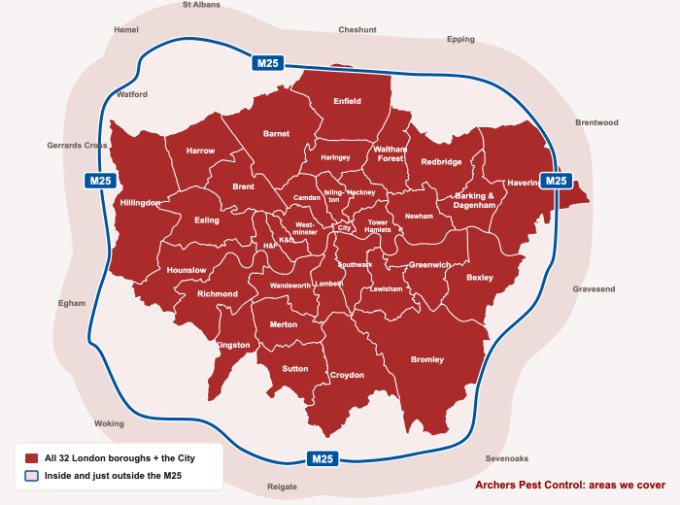
We cover all London boroughs, inside and just outside the M25. These are the areas we are called to most often:
Related Services and Guides

Solutions
About Us
Delivering Pest Control Excellence


